
GLA
Growth Ladder Academy
Grow. Lead. Multiply.
GLA Logo
Growth Ladder Academy
ST
Onboard Level · B303
Entrepreneurship & Innovation
Back to Dashboard Strategic Thinking & Planning Personal Branding & Influence 3Entrepreneurship & Innovation 4Advanced Leadership & Team Building 5Mentorship & Coaching Basics
🚀 Onboard Level Unit 3 of 5 ~60 mins

Entrepreneurship & Innovation

Entrepreneurship is one of the most powerful forces for economic growth, innovation, and societal transformation. At the professional stage, students must understand entrepreneurship not simply as starting a business but as a structured process of identifying opportunities, creating value, and sustaining solutions. This module explores Opportunity Identification & Business Models, and Financial Management & Marketing Fundamentals.

 Module Video Lesson
Video Coming Soon
Upload your B303 video to YouTube and paste the link here
Module Video Lesson
Audio Lesson, Listen On the Go
 Conversational audio overview, perfect for listening while on the go
Audio Lesson, Entrepreneurship & Innovation
Audio file placeholder, upload MP3 to replace this
B303 reference image 1 B303 reference image 2 B303 reference image 3
 Tap any image to view full screen
1
Opportunity Identification & Business Models

Opportunity identification refers to recognizing unmet needs or inefficiencies within a market or society. Opportunities emerge from: persistent social or economic problems, technological advancements, changes in consumer behavior, inefficiencies in existing services, and environmental challenges. Entrepreneurs ask: What problem exists here? Why has it not been solved effectively? How can a better solution be designed?

For an idea to become a viable opportunity it must meet four criteria: Problem-Solution Fit (solves a genuine problem); Market Demand (sufficient people need it); Value Creation (provides clear benefits); Financial Sustainability (can generate enough revenue to continue operating).

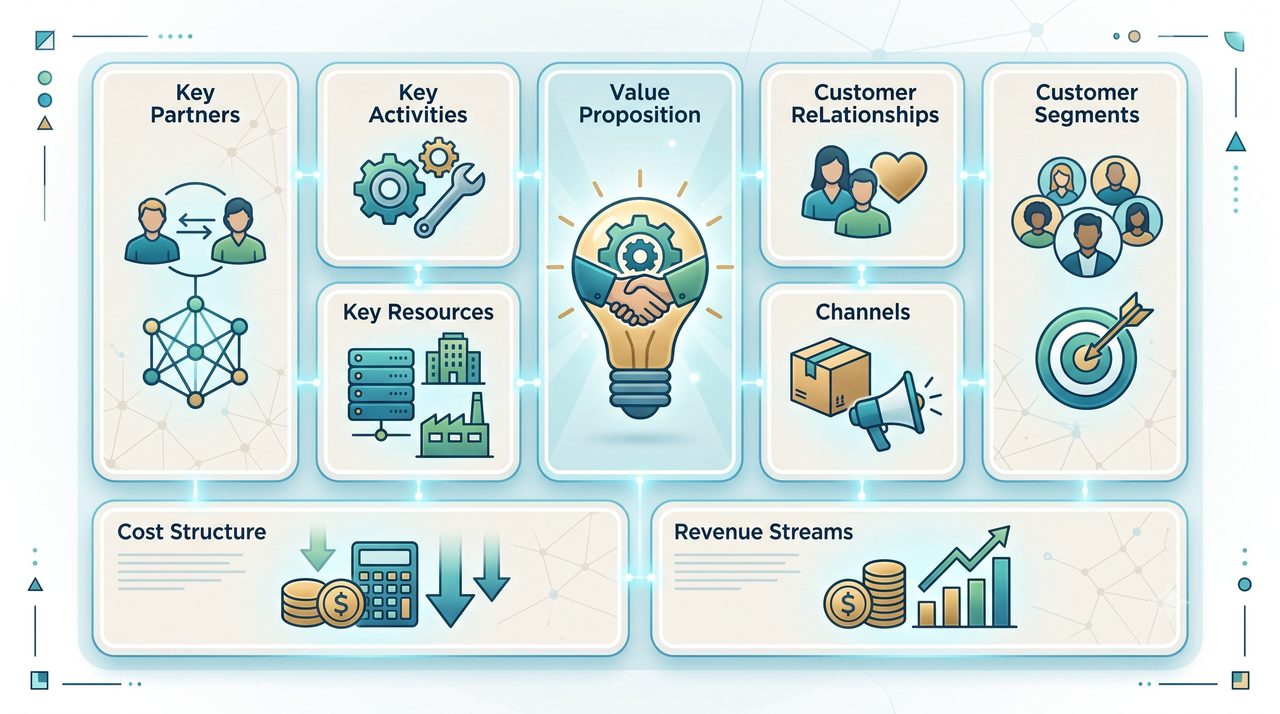
A business model explains how a business creates, delivers, and captures value financially, answering: What value are we offering? How do we deliver that value? How does the business earn revenue? Key components include: Value Proposition, Target Customers, Revenue Streams, Cost Structure, and Distribution Channels.

Key Activities& ResourcesValuePropositionCustomerSegmentsRevenue Streams &Cost StructureA business model maps how you create, deliver and capture value.
📖Case Study
Jeff Bezos, Opportunity Recognition in Technology
In the early 1990s, Bezos noticed that internet usage was growing at an extraordinary rate. He analyzed how the internet could transform retail commerce, realizing that selling books online offered key advantages: standardized products, vast catalogs physical stores couldn't stock, and convenient home delivery. This insight led to Amazon, which began as an online bookstore and evolved into one of the world's largest technology and retail companies, offering cloud computing, digital streaming, and logistics infrastructure.
📖Case Study
Uber, Innovative Business Model Disruption
Travis Kalanick and Garrett Camp introduced a platform-based model connecting passengers with drivers using mobile technology. Instead of owning vehicles like traditional taxi companies, Uber built a digital platform allowing independent drivers to provide transportation services. This created value by providing convenient transportation, flexible earning opportunities for drivers, and technology-optimized payment systems, illustrating how innovative business models can disrupt entire traditional industries.
✍️Personal Activity
Develop a simple business model outline for a product or service idea. Include the problem you want to solve, your target customers, and how you will generate revenue.
👥Group Activity
Work in teams to analyze successful companies such as Amazon, Uber, and Apple, identifying the key elements of their business models.
💭 Reflection Question
Do I evaluate ideas strategically before acting, or do I pursue ideas without structured planning?
2
Financial Management & Marketing Fundamentals

Financial management ensures a business remains sustainable and capable of long-term growth. Many businesses fail not because their ideas are weak but because they manage finances poorly. Key principles: Budgeting, Cash flow management, Profit analysis, and Responsible reinvestment. Entrepreneurs must track financial activities carefully to avoid excessive spending.

Marketing involves communicating the value of a product or service to the right audience, ensuring customers understand what the product does, why it is valuable, and how it solves their problem. Core marketing principles: Target Audience Identification; Value Communication (focus on benefits, not just features); Consistency (strengthens brand recognition); Strategic Visibility (targeted toward likely buyers).

Entrepreneurial success requires balancing financial discipline with effective marketing. Marketing generates visibility and customer demand, while financial management ensures the business remains sustainable. When both function together, businesses can grow responsibly and expand their impact.

Budget CategoryDescription
RevenueIncome generated from products or services
Fixed CostsExpenses that remain constant, such as rent
Variable CostsExpenses that change depending on production volume
Savings / ReinvestmentFunds allocated for future growth and stability
📖Case Study
Warren Buffett, Financial Discipline and Strategic Investment
Buffett built his reputation through careful financial analysis and disciplined investment strategies. Through Berkshire Hathaway, he focused on acquiring companies with strong fundamentals and long-term growth potential. His philosophy emphasizes patience in investment decisions, avoiding unnecessary risk, reinvesting profits wisely, and long-term financial thinking. His approach demonstrates that financial discipline is often more important than chasing short-term profits.
📖Case Study
Steve Jobs, Marketing Innovation Through Apple
Through Apple, Jobs transformed product launches into global events. Apple's marketing emphasized simplicity, elegance, and emotional connection, highlighting how technology enhances human creativity and productivity rather than focusing solely on technical specifications. Products such as the iPhone and MacBook became iconic partly because of strategic marketing that emphasized design, lifestyle, and innovation, showing that how you communicate your value matters as much as the product itself.
✍️Personal Activity
Develop a simple business model outline for a product or service idea, including the problem you want to solve, your target customers, and how you will generate revenue.
👥Group Activity
Work in teams to analyze successful companies, identifying the key elements of their business models and marketing strategies.
💭 Reflection Question
Do I evaluate ideas strategically before acting, or do I pursue ideas without structured planning?
✓ Conclusion

Entrepreneurship and innovation play a crucial role in shaping modern economies and solving global challenges. Successful entrepreneurs require not only creativity but also discipline, strategy, and long-term thinking.

Opportunity identification helps entrepreneurs recognize problems worth solving. Business models provide the structure needed to deliver solutions sustainably. Financial management protects resources, while marketing ensures value reaches the right audience.

Entrepreneurship ultimately reflects a mindset, one that sees possibility where others see limitation and designs solutions where others see problems.

Your reading progress
0% read
Module Progress
0%
B303 completed
Flashcards, tap to reveal
Question
What four criteria must an idea meet to become a viable opportunity?
Tap to reveal answer
Answer
Problem-Solution Fit, Market Demand, Value Creation, and Financial Sustainability.
1 / 5
Quick Quiz
1. What makes an idea a viable business opportunity?
2. What was innovative about Uber's business model?
3. What does Warren Buffett's investment philosophy emphasize?
Module 13 of 20