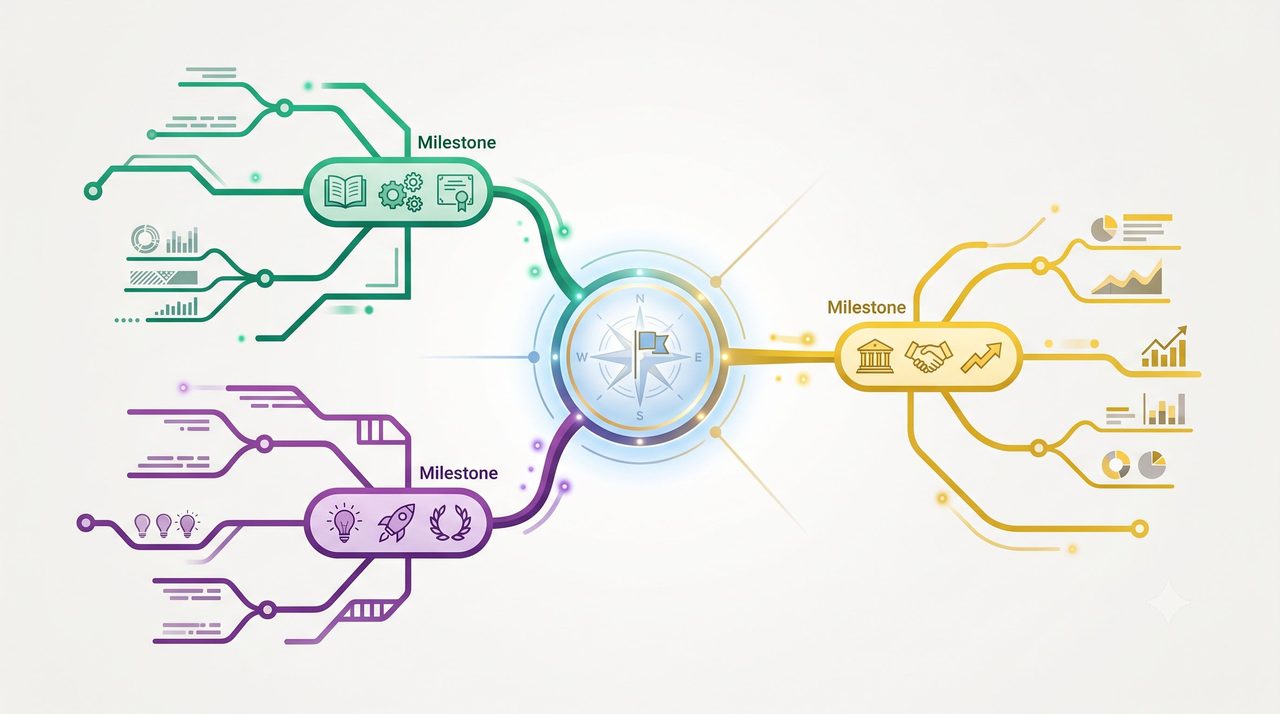
At the professional stage, focus shifts from basic self-improvement to strategic thinking and long-term direction. Many individuals work hard but do not achieve meaningful progress because their efforts are scattered, they respond to immediate pressures rather than working toward a clear future. This module explores two powerful tools: Vision Mapping & Long-Term Thinking, and Systems Thinking & Productivity Mastery.
Module Video Lesson
Video Coming Soon
Upload your B301 video to YouTube and paste the link here
Module Video Lesson
Audio Lesson, Listen On the Go
Conversational audio overview, perfect for listening while on the go
Audio Lesson, Strategic Thinking & Planning
Audio file placeholder, upload MP3 to replace this
Visual Reference Images
Tap any image to view full screen
1
Vision Mapping & Long-Term Thinking
Vision refers to the ability to imagine a future that does not yet exist but is achievable through effort, strategy, and commitment. It answers the question: 'Where do I want to be in the future?' A powerful vision provides motivation because it connects present actions to future outcomes.
Vision also provides clarity, when people know what they want to achieve, they can evaluate opportunities more effectively. Without vision, individuals may focus only on immediate pleasures and miss opportunities that align with their long-term direction.
Vision mapping is a strategic process that translates dreams into actionable plans through key steps: (1) Define the long-term goal; (2) Identify key milestones; (3) Evaluate available resources, education, mentorship, financial investment, networking; (4) Monitor progress and adjust plans. Vision mapping is not rigid, strategic thinkers remain flexible while maintaining overall direction.
📖Case Study
Nelson Mandela, Long-Term Vision in Leadership
Mandela spent 27 years imprisoned for opposing apartheid in South Africa. During this time, many activists became discouraged or sought revenge. However, Mandela maintained a long-term vision of a unified and democratic South Africa. Instead of focusing on personal suffering, he focused on the future of the nation. When released, he worked toward reconciliation rather than revenge, guiding the country toward peaceful democratic transition. His leadership demonstrates that vision requires patience, resilience, and commitment even during extremely difficult circumstances.
📖Case Study
Steve Jobs, Vision in Technological Innovation
At a time when computers were complex and inaccessible to most people, Jobs envisioned personal technology that was simple, intuitive, and integrated into everyday life. Through Apple, he helped create revolutionary products such as the iPhone, iPad, and Macintosh that reshaped global communication, entertainment, and productivity. Jobs's success illustrates how vision combined with strategic execution can transform entire industries.
✍️Personal Activity
Create a five-year vision map outlining your future goals, including educational milestones, skill development, and career aspirations.
👥Group Activity
Students present their vision maps and receive feedback from peers to refine their strategies and goals.
💭 Reflection Question
Are your current habits and daily routines aligned with the future you want to create?
2
Systems Thinking & Productivity Mastery
While vision defines where individuals want to go, systems determine how they get there. Systems thinking involves understanding how different actions, habits, and processes interact to produce outcomes. Instead of relying on occasional bursts of motivation, successful individuals design systems that support consistent progress.
A system is a structured routine or process that produces predictable results. A daily study schedule is a system. A weekly exercise routine is a system. A budgeting plan is a financial system. Systems transform intentions into habits, ensuring progress continues even when motivation is low.
Productivity mastery involves managing time, energy, and priorities effectively. Key principles: Prioritization (identify tasks that produce the greatest impact); Time Management (scheduling important activities); Elimination of Distractions; and Consistency (small actions performed regularly lead to significant results over time).
📖Case Study
Marie Curie, Systems Thinking in Scientific Achievement
Curie dedicated years to systematic scientific research that led to the discovery of radioactive elements such as Radium and Polonium. Her work required meticulous experimentation, careful observation, and structured laboratory routines. She became the first person to win two Nobel Prize awards in different scientific fields, demonstrating how structured systems and disciplined research methods produce groundbreaking discoveries.
📖Case Study
Elon Musk, Productivity Systems in Business
Musk manages several major companies including Tesla and SpaceX. To manage multiple complex organisations, he uses highly structured scheduling systems, his day is often divided into five-minute time blocks, allowing him to allocate time precisely to critical tasks. While such an intense system may not be suitable for everyone, it demonstrates how structured productivity methods allow leaders to manage extremely demanding responsibilities.
📖Case Study
Serena Williams, Athletic Systems and Excellence
Williams followed highly structured training systems throughout her career, physical conditioning, strategic practice sessions, mental preparation, and recovery schedules. These systems allowed her to maintain exceptional performance for decades, making her one of the most successful players in tennis history. Her career demonstrates that excellence often results from consistent routines rather than occasional effort.
✍️Personal Activity
Design a personal weekly productivity system: include daily planning, specific study blocks, and a weekly review session.
👥Group Activity
Students present their vision maps and receive feedback from peers to refine their strategies and goals.
💭 Reflection Question
Are your current habits and daily routines aligned with the future you want to create?
✓ Conclusion
Vision and systems thinking represent two of the most powerful tools for personal and professional success. Vision provides direction and purpose, helping individuals imagine and pursue meaningful futures. Systems ensure consistent execution, transforming intentions into measurable progress.
Historical figures such as Nelson Mandela, Steve Jobs, Marie Curie, and Elon Musk demonstrate how visionary thinking and structured systems contribute to extraordinary achievements.
When vision guides decisions and systems support daily actions, growth becomes deliberate rather than accidental.
Your reading progress
0% read
Module Progress
0%
B301 completed
Flashcards, tap to reveal
Question
What is vision mapping?
Tap to reveal answer
Answer
A strategic process that translates dreams into actionable plans by defining a long-term goal, identifying key milestones, evaluating available resources, and monitoring progress.
1 / 5
Quick Quiz
1. What is the main difference between vision and systems?
2. What did Marie Curie's achievements demonstrate about systems thinking?
3. Why is long-term thinking important in a short-term world?