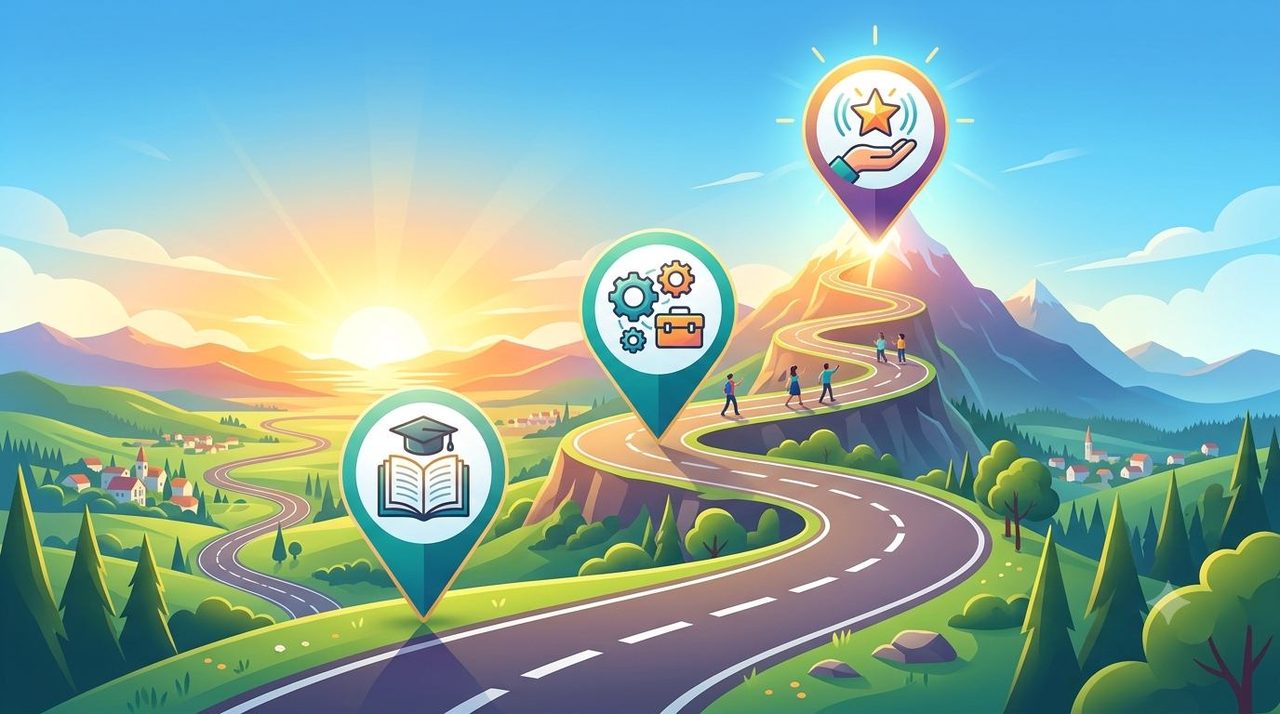
Career direction is not simply about choosing a job, it involves understanding personal strengths, interests, values, and long-term goals. The modern world is changing rapidly due to technological advancement, globalization, and innovation. Many careers that exist today did not exist a few decades ago, and many future careers are yet to be created. Students must develop flexible thinking and transferable skills that allow them to adapt to changing opportunities.
Module Video Lesson
Video Coming Soon
Upload your T205 video to YouTube and paste the link here
Module Video Lesson
Audio Lesson, Listen On the Go
Conversational audio overview, perfect for listening while on the go
Audio Lesson, Career & Direction
Audio file placeholder, upload MP3 to replace this
Visual Reference Images
Tap any image to view full screen
1
Discovering Passion, Skills & Purpose
Passion refers to activities that excite and energize a person, tasks individuals enjoy doing even when they are challenging. Passion creates enthusiasm and motivation important for long-term commitment. However, passion alone does not determine career success; it often develops through learning, practice, and experience.
Skills are abilities developed over time, communication, leadership, creativity, technical knowledge, problem-solving, teamwork. When passion and skill come together, individuals are more likely to excel in their chosen fields.
Purpose connects personal abilities and interests to meaningful contributions to society. Purpose-driven careers allow individuals to use their talents to improve lives, solve problems, and create positive impact. Students can discover their passions and skills by observing activities that energize them and problems they feel motivated to solve.
📖Case Study
Steve Jobs, Passion, Skill and Purpose in Technology
Jobs had a deep passion for technology, design, and innovation. His skills in creativity, leadership, and product development helped him transform that passion into revolutionary products. Through Apple, Jobs helped create products such as the iPhone and Macintosh, which changed the way people communicate, work, and access information. His work demonstrates how passion and skill can create a purpose that transforms entire industries.
📖Case Study
Malala Yousafzai, Purpose-Driven Career
Growing up in Pakistan, Malala developed a strong passion for education. When extremist groups attempted to prevent girls from attending school, she courageously spoke out. Despite facing threats and surviving an attack, Malala continued advocating for educational equality around the world. Her commitment to purpose led her to become the youngest recipient of the Nobel Peace Prize, illustrating how passion aligned with purpose can inspire global change.
✍️Personal Activity
Write a list of five activities that energize you and identify three skills you currently possess.
👥Group Activity
In groups, share your passions and skills and brainstorm possible career paths that could align with them.
💭 Reflection Question
What activities make you lose track of time, and what might that reveal about your purpose?
2
Career Exploration & Goal Mapping
Career exploration involves researching different professions, understanding educational requirements, and evaluating whether a career aligns with personal interests and abilities. Many students form career ideas based on limited information, assuming popular careers without understanding the specific skills, training, and responsibilities involved.
Key questions for career exploration: What qualifications are required? What skills are necessary? What challenges and responsibilities are involved? What opportunities exist for growth? Goal mapping breaks long-term ambitions into smaller achievable steps, making progress clearer and more achievable.
Career paths are rarely perfectly straight. Opportunities, challenges, and changing interests may lead individuals in new directions. Flexibility and adaptability are therefore essential qualities for career success in the modern world.
📖Case Study
Barack Obama, Strategic Goal Mapping Through Public Service
Obama's career path involved several stages: studying law, becoming a community organizer, serving as a senator, and eventually becoming president of the United States. His journey shows how long-term goals often develop gradually through education, experience, and public service. Each step in his career contributed to leadership skills and knowledge that prepared him for higher responsibilities.
✍️Personal Activity
Create a career roadmap for one career you are interested in, listing educational requirements, skills needed, and 3 milestone steps to get there.
👥Group Activity
Work in teams to create a career roadmap chart showing education requirements, skills, and possible career pathways.
💭 Reflection Question
What steps can you take this year to strengthen your skills and move closer to your future career goals?
3
Entrepreneurship & Innovation
Entrepreneurship is the ability to identify opportunities, solve problems creatively, and create value. While often associated with starting businesses, the entrepreneurial mindset can be applied in education, technology, science, and social development. Entrepreneurs observe problems in society and develop solutions that improve people's lives.
Students who develop entrepreneurial thinking learn to view problems as opportunities for innovation rather than obstacles. Key entrepreneurial qualities: creativity, initiative, resilience, and the ability to learn from failures.
📖Case Study
Elon Musk, Innovation Solving Global Challenges
Musk founded innovative companies such as Tesla (electric vehicles that reduce environmental pollution) and SpaceX (revolutionizing space travel). His entrepreneurial vision demonstrates how innovation can address global challenges such as sustainable energy and space exploration.
📖Case Study
Bill Gates, Entrepreneurship for Global Impact
Gates helped build Microsoft, which developed widely used software such as Microsoft Windows, playing a major role in making personal computers accessible worldwide. Later in life, he also applied entrepreneurial problem-solving to global health and development through the Bill & Melinda Gates Foundation, demonstrating that entrepreneurship can be a powerful force for positive change beyond business.
✍️Personal Activity
Identify one problem in your school or community and brainstorm an innovative solution that you could develop.
👥Group Activity
Work in teams to create a career roadmap chart showing education requirements, skills, and possible career pathways.
💭 Reflection Question
What problem in your community could you solve with the skills you already have or are developing?
4
Building a Professional Profile
Career success also depends on how individuals present themselves professionally. A resume is a document that summarizes a person's education, skills, accomplishments, and experiences. Even students can begin developing simple resumes that highlight achievements such as academic awards, leadership roles, volunteer work, and participation in projects.
Networking involves building relationships with people who can offer guidance, mentorship, or opportunities, teachers, mentors, professionals, or community leaders. Networking is not simply about asking for help; it is about developing genuine relationships based on respect, learning, and collaboration.
Maintaining a positive digital reputation is essential. In the modern world, employers and institutions often review online profiles before offering opportunities. Students should use social media responsibly and present themselves professionally online.
📖Case Study
Mark Zuckerberg, The Power of Networking
Zuckerberg created Facebook while studying at Harvard University. His connections with fellow students and technology experts helped him develop the platform into one of the world's largest social networks. Networking, building genuine relationships with people who share your vision, was a critical factor in Facebook's early success.
📖Case Study
Oprah Winfrey, Networking and Professional Relationships
Through strong communication skills and professional relationships, Oprah built a powerful media network that includes television, publishing, and film production. Her company Harpo Productions opened opportunities for many professionals. Her career demonstrates that genuine relationships built on respect and shared goals can open extraordinary doors.
✍️Personal Activity
Create a simple one-page student resume listing your education, achievements, skills, and any activities or volunteer work.
👥Group Activity
Practice introducing yourself professionally in 60 seconds, a skill known as the 'elevator pitch.'
💭 Reflection Question
How do you present yourself online, and does it reflect the professional you want to become?
✓ Conclusion
Career development is a gradual process that requires self-awareness, exploration, planning, and continuous learning. Discovering passion, skills, and purpose helps students understand their strengths and interests. Career exploration and goal mapping provide direction and motivation.
Entrepreneurial thinking encourages creativity, resilience, and problem-solving. Building a professional profile, through a resume, networking, and a positive digital reputation, prepares students for future opportunities in education and employment.
The examples of Steve Jobs, Malala Yousafzai, Elon Musk, Bill Gates, and Oprah Winfrey demonstrate how passion, preparation, and persistence lead to meaningful success. Career clarity develops through continuous learning, reflection, and experience.
Your reading progress
0% read
Module Progress
0%
T205 completed
Flashcards, tap to reveal
Question
What are the three elements of career discovery?
Tap to reveal answer
Answer
Passion (activities that energize you), Skills (abilities developed over time), and Purpose (connecting your abilities to meaningful contributions to society).
1 / 5
Quick Quiz
1. What is the difference between passion and purpose in career development?
2. What does Barack Obama's career path demonstrate about goal mapping?